How Smaller Sized Assisted Living Communities Support Families Facing Dementia
Business Name: BeeHive Homes of Henderson
Address: 1000 Greenway Rd, Henderson, NV 89002
Phone: (702) 551-0265
BeeHive Homes of Henderson
At BeeHive Homes of Henderson, Nevada, we offer the finest assisted living and memory care experience available in a cozy, comfortable homelike setting. Each of our residents has their own spacious room with an ADA approved bathroom and shower. We prepare and serve delicious home-cooked meals three times a day every day. We maintain a small, friendly community of only 20 residents per home. We provide regular activities that our residents find fun and contribute to their health and well-being. Our staff is attentive and caring and provides assistance with daily activities to our residents in a loving and respectful manner. We would like to invite you to tour and experience our memory care & assisted living home and feel the difference.
1000 Greenway Rd, Henderson, NV 89002
Business Hours
Families seldom start their search for dementia care with a clear strategy. More frequently, it starts with a fall, a frightening episode of roaming, or a call from a next-door neighbor who noticed something is wrong. By the time individuals inquire about assisted living or memory care, they are typically exhausted, guilty, and uncertain what "great care" even looks like.
That uncertainty is reasonable. The senior care landscape is puzzling, the language is inconsistent, and the stakes feel painfully high. Among the most essential options families deal with is the size and kind of neighborhood they pick. Large buildings with numerous residents look outstanding on pamphlets, but smaller sized assisted living and memory care settings frequently provide something households frantically need: intimacy, flexibility, and individualized support for dementia care.
This is not merely a matter of taste. The size and culture of a community affect almost everything that takes place inside it, from the way medication is offered to how a tough night gets handled when somebody is sundowning and refusing to go to bed.
Why size and scale matter for dementia care
Dementia changes how an individual experiences the world. Noise, visual mess, and consistent strangers can feel frustrating. Complex regimens can puzzle. Staff who do not know the resident's history might misinterpret behavior that has a clear trigger.
In big senior care communities, it can be difficult to control these elements. The structure itself frequently determines the environment: long passages, big dining-room, a turning cast of caregivers covering several floors. That design can work for some older adults who are physically frail but cognitively undamaged. It is less perfect for someone who has forgotten where their space is or who becomes distressed when surrounded by dozens of individuals at mealtimes.
Smaller assisted living or devoted memory care communities, particularly those designed for 6 to 40 citizens, operate extremely differently. The environment feels more like a home than an institution. Personnel can reasonably understand each resident and household by name, understand their routines, and spot subtle changes early.
Size alone does not ensure quality, however it ensures good practices a lot more feasible.
What "little" often looks like in practice
Families in some cases image "little" as less equipped or less professional. In truth, many of the greatest dementia care programs I have actually seen are in:
- Standalone memory care homes with 6 to 16 residents, frequently converted homes or purpose-built single story homes
- Boutique assisted living communities with a couple of little buildings and under 50 homeowners per building
These settings are typically certified as assisted living or residential care, sometimes with a dedicated memory care recommendation depending on state regulations. They generally offer assist with bathing, dressing, meals, medications, and day-to-day guidance, plus structured dementia care programming.
The secret difference is scale. A caregiver in a small neighborhood may be responsible elder care for 4 to 8 homeowners instead of 12 to 18. The nurse can walk the entire structure in a couple of minutes. Families can discover the executive director without navigating a business phone tree.
Smaller size likewise means fewer layers between the people who set policy and the people who provide care. If something is not working, it is simpler to adjust quickly.
The psychological reality for families
When a parent or spouse develops dementia, families are not just looking for housing. They are grieving the loss of the individual they understood, while still needing to advocate for the person who remains.
In discussions with adult kids making these decisions, several themes repeat:
They feel guilty that they can not "do it all" at home.
They fret their loved one will feel abandoned. They fear institutional environments that strip people of their identity. They are worn out, sometimes alarmingly so, after months or years of caregiving.Small assisted living and memory care settings can ease a few of that psychological burden in ways that are easy to miss on a checklist.
In a smaller sized location, households tend to see the very same faces each time they visit. They construct relationships not simply with a director and nurse, however with the caregivers who deal with dressing, meals, and personal care. These regular interactions make it much easier to share information about the resident's history and choices, and to get sincere feedback about how things are going.
One daughter informed me that in the big community they attempted initially, she felt like a visitor at a hotel. After moving her mother to a 12 bed memory care home, she stated, "Now when I are available in, they hand me a cup of coffee, tell me what type of morning she had, and ask how I am doing too." That sense of partnership is not a high-end. It is a protective aspect for both the resident and the family.
How smaller neighborhoods adapt daily life for dementia
Dementia care is not merely "more assisted living." It requires specific, constant adaptations in the environment and day-to-day routine. Smaller sized communities are often better placed to supply these in a continual, human way.
Familiar routines and flexible schedules
In a big building, schedules tend to be stiff, due to the fact that personnel have to move dozens of people through meals, medications, and activities. Anyone who withstands or moves slowly can feel like a problem to be resolved quickly.
Smaller settings normally have more versatility. Breakfast might be readily available over a longer window, and caregivers can change individual care routines based on when each resident is most cooperative. That versatility matters a great deal for someone with dementia who awakens disoriented or is calmer in the afternoon than the morning.
I have actually seen caretakers in small homes shift a whole bathing schedule around one resident who did much better with evening showers, merely because they could. They did not have to run the idea through 3 levels of management or reword an entire staffing plan.
Sensory environment and noise
Dementia frequently makes people more conscious sound and visual stimuli. A congested dining room with clattering meals, overlapping discussions, and background music can tip someone from somewhat confused into fully agitated.
In a little assisted living or memory care home, dining rooms are normally intimate. There might be 2 smaller sized tables instead of one large one, with staff distributing at eye level, not rushing behind carts. The cooking area may be noticeable, permitting homeowners to smell food cooking, which can promote appetite and enhance a sense of regular home life.
Common areas in little neighborhoods likewise tend to be less aesthetically overwhelming. Fewer hallways, fewer entrances, fewer people moving unexpectedly. For an individual whose brain is already working overtime to translate the world, that simplicity can reduce anxiety significantly.
Staff continuity and relationship-based care
One of the clearest advantages households notification is staff consistency. Because smaller sized communities need fewer workers overall, schedules are typically built around stable core teams. That stability allows authentic relationships, which are particularly important in dementia care.
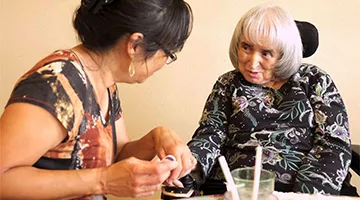
When the very same caregiver deals with your mother each morning, they learn how to approach her so she does not feel threatened during bathing. They observe that she chooses her cardigan before breakfast, or that she consumes more when fruit is offered first. These are not little information. They can be the distinction between a calm day and a series of behavioral escalations.
In large, extremely staffed centers, turnover and rotation can be greater. Even when specific caretakers are kind and capable, the constant circulation of new faces can be confusing for homeowners and tiring for families who have to re-explain history and preferences with every change.
Support beyond the resident: how families are cared for
Good senior care neighborhoods comprehend that dementia impacts entire family systems. The caregiving spouse or adult child frequently needs as much support as the resident does. Smaller sized communities are uniquely positioned to offer that assistance informally, which for lots of households feels more natural and available than formal programs.
Communication that feels human, not corporate
Regular, sincere interaction is the top aspect that figures out whether households feel confident in a care setting. In little assisted living and memory care neighborhoods, there are simply fewer people associated with decision making. You are more likely to hear straight from the nurse or director about medication modifications, behavioral shifts, or health concerns.
Instead of automated e-mails and mass newsletters, updates may come as fast phone calls or text messages: "Your dad has been a little more unstable this week. We are keeping a better eye on him and want to talk about physical therapy." This style of communication builds trust, and trust makes it much easier to weather the inescapable hard days.
Families also tend to feel more comfortable raising issues, since they understand who to talk with and do not feel like they are participating in a formal complaint process every time they have a question.
Emotional support and informal coaching
Many caretakers silently confess they do not totally comprehend dementia. They puzzle typical disease development with "bad days," or analyze resistance as stubbornness rather of worry. Smaller neighborhoods typically respond to this more organically.
A skilled caretaker might pull a partner aside and state, "When he states he wishes to go home, he might be searching for security, not a specific house. Here is how we normally respond when he is in that mood." These off the cuff conversations, constructed on familiarity and trust, can transform how households approach visits.
In a bigger setting, comparable education may technically exist, however get lost in scheduled workshops that households can not participate in because they are handling tasks, children, and visits. Smaller neighborhoods can weave education into everyday interactions.
The function of respite care in smaller settings
Not every household is prepared for a full shift to assisted living or memory care. Some wish to keep their loved one in the house as long as possible, but need breaks to rest, travel, or recuperate from their own health concerns. This is where respite care becomes a necessary tool.
Respite care describes short term remains in a senior care neighborhood, usually from a couple of days to several weeks. Smaller neighborhoods that use respite stays can be especially handy for households dealing with dementia, for numerous reasons.
First, the environment is less overwhelming for someone being available in from home. There are less brand-new faces and a simpler design to find out. Personnel can take some time to understand the person's routines and choices, because there are not 150 other locals showing up and leaving.
Second, respite remains in small communities can double as a gentle trial run. Households can see how their loved one responds to a different environment without making an immediate long term dedication. I have actually seen households use three or four separate respite stays over a year before selecting a long-term move, each time adjusting care methods based upon what they learned.
Finally, respite care protects caregivers from burnout. A typical pattern is a dedicated spouse or adult child caring alone in your home till a crisis forces an emergency situation positioning. Time-outs in a familiar small community can prevent that cliff, extending safe care in the house while developing a relationship with a team that may eventually end up being the full-time care provider.
Safety, supervision, and dignity in small environments
Families are not surprisingly focused on safety once dementia remains in the picture. They stress over roaming, falls, kitchen accidents, and medication mistakes. Smaller sized assisted living and memory care communities typically have advantages here, but the photo is nuanced.
With fewer homeowners and more compact spaces, staff can keep an eye on motion and habits better. If a resident tries to leave through a door, there is a good chance a caretaker neighbors, not on the far side of a massive building. Alarms, safe yards, and door codes might still be used, however they complement, rather than change, human observation.
There is also more opportunity to provide guidance that maintains dignity. For example, rather of silently disabling an elevator button or locking every door, a caretaker who understands the resident may reroute with a familiar task or basic walk: "Let us go examine the garden together first." It is much easier to do this consistently when staff are not extended across multiple wings.
However, there are trade offs. Little communities generally have fewer on site resources than large campuses. A huge building may have on website physical therapy health clubs, comprehensive activity personnel, or a devoted medical clinic. A smaller home might contract those services or offer them in a more modest kind. Households need to consider which matters more for their specific circumstance: concentrated individual attention, or the benefit of lots of amenities under one roof.
Trade offs and when a small setting may not be ideal
While I have actually seen many successes in small assisted living and memory care environments, they are not immediately the very best fit for every person with dementia.
Some people, especially those who are really social or physically active, might prefer a bigger setting with more structured group activities, numerous dining options, or on site religious services. A highly shy person may grow in a small house where the very same ten people share meals every day, but somebody who has actually constantly loved hectic environments may discover it too quiet.
There are also medical considerations. People with sophisticated dementia typically establish intricate physical health issue. In some regions, big senior care communities partner carefully with on site physicians, therapy providers, and even urgent care centers, which can lower trips out to appointments. A very small memory care home may handle similar needs well, or may rely more greatly on external service providers and household transportation, depending on staffing and local regulations.
Cost is another element. Smaller sized, more intimate settings can be more expensive each month, particularly if they maintain low resident to personnel ratios. On the other hand, some residential care homes are remarkably economical compared to high end big centers, exactly due to the fact that they do not buy grand lobbies and substantial amenity spaces.
It is important for families to look beyond marketing language like "homelike" or "state of the art" and evaluate healthy based on the individual's history, personality, medical needs, and phase of dementia.
What to try to find when exploring a little assisted living or memory care community
Once you have actually identified a couple of smaller communities, the tour is where you will collect the details that matters beyond glossy brochures. A great tour in a small setting need to feel like being invited into somebody's home, not escorted through a sales presentation.
When you visit, pay attention to how staff engage with locals in genuine time. Are names used consistently? Do caretakers make eye contact and speak at a calm, measured rate? Notice whether homeowners appear relaxed, engaged, and properly groomed. Listen for laughter as well as the periodic outburst, which is regular in dementia care however should be met calm, skilled responses.
It also helps to have a focused set of questions, preferably made a note of. For lots of households, this short list works well:
- What is your typical staff to resident ratio throughout days, nights, and nights, specifically in the memory care or high needs location?
- How long have the majority of your caregivers and nurses worked here, and who offers direct dementia care training?
- How do you manage medical modifications or behavioral crises, and who contacts families when something considerable takes place?
- Do you provide respite care stays, and if so, how are those citizens incorporated into every day life?
- How do you support families emotionally and practically as dementia progresses, particularly around hard decisions like hospice?
Their responses will inform you not only about policies, however also about values. A director who lights up when talking about their team's longevity and training, or who readily shares specific stories about how they managed a difficult scenario, is providing you more than info. They are giving you insight into the culture your household would be joining.
Integrating home, health center, and community care
Dementia care does not happen in isolation. Over the course of the illness, families normally navigate a web of supports: primary care doctors, neurologists, hospitals, home health agencies, hospice, and several senior care communities.
Smaller assisted living and memory care settings frequently play a peaceful collaborating function in this network. Because they know citizens closely, they are well placed to notice subtle indications that something is off: a change in gait, brand-new confusion, decreased appetite, or interfered with sleep. This can trigger prompt medical examination, preventing larger crises.
From a household point of view, it is much easier to coordinate when there is a single point individual in the community who understands both the resident and the outdoors companies. In the majority of little settings, that person is a nurse or supervisor who has worked there enough time to understand the circulation of the local health system.
When done well, this coordination minimizes unnecessary hospitalizations, supports smoother transitions to hospice when proper, and keeps households informed and included, instead of blindsided by abrupt changes.
Making peace with the decision
No senior care setting, big or little, can get rid of all the pain of watching dementia development. What it can do is share the weight of caregiving in such a way that preserves dignity for the person with dementia and sustainability for the family.
Smaller assisted living and memory care communities are frequently better matched to that job since they operate on a scale that matches human relationships. Staff can truly understand citizens as individuals. Families can form real collaborations with individuals supplying daily dementia care. Adjustments can be made rapidly, based upon observation instead of bureaucracy.
That does not indicate every little neighborhood is right, or that bigger settings have nothing to use. The best option is the one where your loved one is seen, comprehended, and regularly supported, and where you, as family, feel consisted of instead of sidelined.
If you reach that point in a small, quiet memory care home with 12 citizens and a well worn couch in the living-room, you have actually not "quit." You have expanded the circle of people who appreciate your parent or partner. For a lot of families dealing with dementia, that is not a failure of duty. It is an act of love, and typically, an extensive relief.
BeeHive Homes of Henderson provides assisted living care
BeeHive Homes of Henderson provides memory care services
BeeHive Homes of Henderson provides respite care services
BeeHive Homes of Henderson supports assistance with bathing and grooming
BeeHive Homes of Henderson offers private bedrooms with private bathrooms
BeeHive Homes of Henderson provides medication monitoring and documentation
BeeHive Homes of Henderson serves dietitian-approved meals
BeeHive Homes of Henderson provides housekeeping services
BeeHive Homes of Henderson provides laundry services
BeeHive Homes of Henderson offers community dining and social engagement activities
BeeHive Homes of Henderson features life enrichment activities
BeeHive Homes of Henderson supports personal care assistance during meals and daily routines
BeeHive Homes of Henderson promotes frequent physical and mental exercise opportunities
BeeHive Homes of Henderson provides a home-like residential environment
BeeHive Homes of Henderson creates customized care plans as residents’ needs change
BeeHive Homes of Henderson assesses individual resident care needs
BeeHive Homes of Henderson accepts private pay and long-term care insurance
BeeHive Homes of Henderson assists qualified veterans with Aid and Attendance benefits
BeeHive Homes of Henderson encourages meaningful resident-to-staff relationships
BeeHive Homes of Henderson delivers compassionate, attentive senior care focused on dignity and comfort
BeeHive Homes of Henderson has a phone number of (702) 551-0265
BeeHive Homes of Henderson has an address of 1000 Greenway Rd, Henderson, NV 89002
BeeHive Homes of Henderson has a website https://beehivehomes.com/locations/henderson/
BeeHive Homes of Henderson has Google Maps listing https://maps.app.goo.gl/qpZ3TKgbxCu1MVSh8
BeeHive Homes of Henderson has Instagram page https://www.instagram.com/beehivehomeshenderson/
BeeHive Homes of Henderson has an YouTube page https://www.youtube.com/@hamiltonshives4468
BeeHive Homes of Henderson won Top Assisted Living Homes 2025
BeeHive Homes of Henderson earned Best Customer Service Award 2024
BeeHive Homes of Henderson placed 1st for Senior Living Communities 2025
People Also Ask about BeeHive Homes of Henderson
What is BeeHive Homes of Henderson Living monthly room rate?
Our base rate is $4,700 per month for assisted living and $5,700 per month for memory care plus a one-time community fee of $2,500. We do an assessment of each resident's needs prior to move-in, so each resident's rate may be higher. These prices fall into three tiers based on resident needs and range from $4,700/month to $7,300/month. However, after we do the assessment and quote a price, there are no add-ons or hidden fees
Does Medicare and Medicaid pay for a stay at Bee Hive Homes?
Medicare pays for hospital and nursing home stays, but does not pay for assisted living. Some assisted living facilities are Medicaid providers but we are not. We do accept private pay, long-term care insurance, and we can assist qualified Veterans with approval for the Aid and Attendance program
Do we have a nurse on staff?
We do have a nurse on contract who is available as a resource to our staff but our residents' needs do not require a nurse on-site. We always have trained caregivers in the home and awake around the clock
What can you tell me about the food at Bee Hive?
You have to smell it and taste it to believe it! We use dietitian-approved meals with alternates available for flexibility, and we can accommodate needs for different textures and therapeutic diets. We have found that most physicians are happy to relax diet restrictions without any negative effect on our residents
Do we allow pets?
We do allow small pets as long as the resident is able to care for them. State regulations also require that we have evidence of current immunizations for any required shots
Where is BeeHive Homes of Henderson located?
BeeHive Homes of Henderson is conveniently located at 1000 Greenway Rd, Henderson, NV 89002. You can easily find directions on Google Maps or call at (702) 551-0265 Monday through Sunday 9:00am to 5:00pm
How can I contact BeeHive Homes of Henderson?
You can contact BeeHive Homes of Henderson by phone at: (702) 551-0265, visit their website at https://beehivehomes.com/locations/henderson/ or connect on social media via Instagram or Facebook
You might take a short drive to the Shan-Gri-La Prehistoric Park (aka the Dinosaur House). Shan Gri La Prehistoric Park provides a unique local attraction where families supporting loved ones through Assisted living memory care senior care elderly care and respite care can enjoy a memorable outing together.